
Security posture has historically improved through a recognizable cycle. New platforms emerge. Early deployments prioritize functionality. Incidents reveal systemic weaknesses. Over time, standards, tooling, and operational discipline converge to reduce risk. What AI adoption is doing, and what earlier platform transitions have done to a lesser extent, is compressing that cycle significantly. Deployments are accelerating faster than the institutions responsible for governing security maturity can realistically respond.
For organizations operating sensitive training data, proprietary models, high-throughput inference systems, or high-value customer assets, this shift is not theoretical. It is already shaping architectural decisions, capital allocation, and operational resilience in ways that are invisible until exposed.
Exposure Is Structural, Not Incidental
In earlier eras, sensitive assets were easier to bound. A production database isolated within a private network segment. A proprietary algorithm existing primarily inside application binaries. Even as cloud adoption began to distribute systems geographically, security perimeters remained conceptually tractable.
AI systems are materially different in this respect, but the underlying dynamic is not as novel as it first appears. Any platform that makes assets more mobile, more distributed, and more integrated across organizational boundaries tends to expand the surface that requires protection. Cloud-native architectures produced this effect. API-first product strategies produced it. AI infrastructure is producing it at a new order of magnitude, because the assets involved, including datasets, model weights, embeddings, and intermediate training artifacts, are both highly mobile and long-lived. Their value persists long after their original use case.
The post-quantum readiness problem I wrote about earlier sits inside this same frame: assets retain strategic sensitivity long after the cryptographic assumptions protecting them expire. That gap is not unique to cryptography. It runs throughout the infrastructure stack and compounds with each platform transition.
Institutional Learning Cannot Keep Pace
Part of the challenge is cultural rather than purely technical, and it is the same cultural problem the prior piece in this series examined from a different angle. Engineering organizations have historically learned security lessons through repetition. Misconfigured databases exposed to the public internet. Insecure APIs deployed under time pressure. Weak access controls discovered only after breach or near-miss. Over time, institutional memory developed, best practices hardened, and tooling improved.
The honest version of this observation is that I have not personally seen a major model registry misconfiguration surface in a production environment, yet. That is not reassuring. In my experience, the absence of a visible failure usually means the exposure exists and has not yet been interrogated, not that it is not there. And the exposure is beginning to surface. The Claude Code source code leak that became public earlier this month is an early example of exactly this class of failure: an AI development tool exposing sensitive assets through an insufficiently governed artifact boundary.
The patterns are recognizable: an S3 bucket never reassessed when the data became commercially sensitive. An internal API ran without authentication for months. A misconfigured VPC peering change exposed it quietly, with no alert and no audit trail.
I worked with a team building a security feed distribution system. Clients used an ETag to optimize performance; clients checked the content hash and skipped downloads when nothing had changed. The mechanism is well known and the implementation was sound. Early in production, the feed team pushed a malformed payload that violated their data contract with the product team. It was caught, promptly removed, and systems recovered on their next scheduled update.
Several years later, a bug in the pipeline pushed a zero-byte file with the non-zero file ETag. The product went into a crash loop. The security team fixed the bug, and an update was deployed, but the issue persisted. The client had implemented the ETag for performance but not data integrity. Resolution required an additional push with modified content. Between service windows and exponential backoff, full remediation took weeks.
The caching contract had not survived after the engineers built it. Nobody responding to the incident understood how the system worked let alone fix it. A decade later, I was in the room when a different team prepared the same pattern. Without the accident of presence, it would have shipped.
This was not an exotic risk. It is a variation of long-established patterns, reintroduced under the banner of each new infrastructure era. AI adoption is introducing a layer of abstraction that can reset the institutional learning curve entirely. Teams adopting novel model-serving frameworks or data pipelines often treat them as fundamentally new problems rather than evolutionary extensions of distributed systems.
The External Environment Is Not Waiting
At the same time, the external environment is becoming less forgiving. Attack surface expansion driven by rapid adoption is intersecting simultaneously with increasing sophistication of financially motivated cyber actors, sustained nation-state investment in offensive capability, growing regulatory scrutiny of data handling, and emerging timelines for post-quantum cryptographic transition.
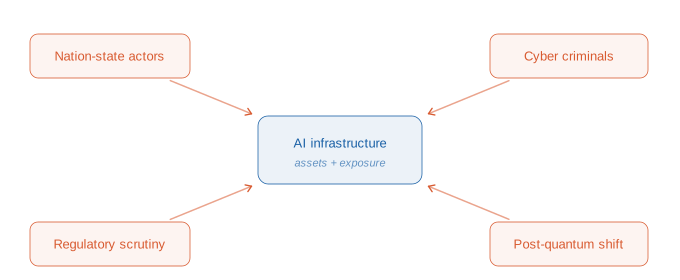
Each of these forces has existed independently. Their convergence is what makes the current moment distinctive. Organizations are being asked to operate more complex systems, distribute more valuable assets, and adopt new cryptographic paradigms, while competitive pressure discourages any slowdown.
In practice, security maturity is treated as something to catch up on after core platform milestones are achieved. That sequencing feels rational in the short term and some team dynamics force this. Over time, it embeds exposure into architectural assumptions rather than addressing it at the surface.
The Three Planes Do Not Fail the Same Way
Exposure propagates differently across the control, data, and artifact planes, and the security posture of each requires distinct treatment.
On the control plane, rapid scaling can introduce coordination fragility. Service meshes, identity systems, and orchestration layers become responsible for establishing trust relationships at machine speed. Burst conditions, authentication overhead, certificate churn, and retry behavior can interact in ways that degrade both resilience and security visibility simultaneously. Another inspection product I worked on used a well-known proxy to do decryption; ephemeral key management created an ownership gap during configuration, and with it the risk of decrypted data persisting in memory beyond its intended scope.
On the data plane, the economics of high-throughput compute encourage optimization strategies that may inadvertently increase exposure. A 400G packet processor I worked on was one of the first to upgrade zero-copy drivers using Intel DPDK. Our first release experienced a performance dip starting around 8 months of uptime. Intel could not explain it, and their sample program seemed to work. Tracing the full pipeline revealed the gap: nothing assumed responsibility for reclaiming in-flight packets orphaned on worker crash.
On the artifact plane, lifecycle risk becomes dominant. Models and datasets have not accumulated contracts or gained provenance at the same rate before. One of the early teams I worked with based a feature on a widely used geolocation database. A few years later, when a legacy country code disappeared from the feed, the product reported no traffic for IPv6 prefixes. The system behaved correctly given its inputs. The problem was that its inputs carried an implicit assumption: the authoritative source would only ever add or update, never retract. That assumption was never written down, never tested, and never challenged until it was violated. The longer an artifact outlasts its assumptions, the more likely it is to intersect with a change it was never built to absorb.
Security maturity is rarely distributed evenly across all three planes. Leaders who assume a single control mechanism can address all three will discover otherwise under conditions they did not select.
Compliance Theater
FIPS certification is scoped to a specific major and minor version. Patch releases for bug and security fixes are exempt, which is a reasonable accommodation. What is not reasonable is what some vendors did with it: they restructured their versioning scheme so that what would have been a minor version bump was reclassified as a patch. The certification window stayed open. The software kept shipping. The guardrail was intact on paper and irrelevant in practice.
That outcome is not a loophole story. It is an incentive story. When compliance creates friction and competitive pressure creates urgency, teams find the seam between the two. Security governance that does not account for that dynamic is not governance. It is documentation.
Building Maturity Faster Than Exposure Accumulates
Even when technical leadership recognizes these dynamics, organizational incentives complicate mitigation. Security proposals are routinely perceived as strategic risk rather than risk reduction, and that perception is not entirely wrong: opportunity cost is also a form of exposure.
The costs of insufficient security maturity emerge during incident response, regulatory action, or forced architectural rework. They do not appear on the velocity metrics used to celebrate progress.
Addressing this imbalance is less about adopting a specific toolset and more about building organizational capacity. Reframing security as an operational systems characteristic rather than a compliance obligation means explicitly modeling the lifecycle of high-value artifacts, stress-testing trust mechanisms under realistic scaling conditions, and ensuring that security review bandwidth grows alongside feature velocity. These actions introduce friction in the short term and reduce the probability that exposure becomes a structural constraint on future growth.
Organizations that accumulate technical capability quickly while deferring security maturity are not building resilient platforms: they are building systems whose failure modes have not yet been discovered. That distinction will matter most at exactly the wrong moment.
The same competitive pressure that defers security investment can quietly hollow out the governance meant to enforce it.
The organizational side of this challenge, how engineering teams must be structured to absorb accelerating complexity without losing velocity, is the subject of the final piece in this series.