
Some years ago I was asked to evaluate a proposed feature for a DDoS product. The concept was straightforward: full forensic analysis at line rate. The product team had found something they believed would differentiate them, the feature was scoped, effort was roughly estimated, and leadership was sold. The product manager had the roadmap slot and the momentum that comes with it.
When I saw the design I asked a single question: how much storage would the capture require at line rate, which was 100G at the time. No one on the team had run the number. When I did, the answer was not merely expensive. It was a physical impossibility inside the hardware budget. The feature as specified could not exist. I was certain of it, and being certain turned out to be the easy part. Convincing the room was not. I had several uncomfortable conversations with the product manager, and no version of the arithmetic moved him. He had a demo narrative, a sold concept, and a plan. I had a correct objection and not enough standing to spend against his momentum. The feature came off the roadmap only after the chief architect intervened. The arithmetic did not change. The standing behind it did.
The lesson was not about storage. It was about standing. The brake on a bad engineering decision is rarely missing. What fails is the ability to apply it in time and against resistance, and that ability has always been social before it was technical. What I have been thinking about lately is how AI tooling has quietly made that resistance harder to overcome.
The Brake Exists, and It Was Always Bypassable
Every mature engineering organization has mechanisms that function as brakes on bad decisions: structural ones like design reviews and architecture sign-off, social ones like the senior engineer who asks the uncomfortable question, cultural ones like the norm that proves a thing in a proof-of-concept before committing to it. These are not bureaucracy, though they can calcify into it. They are organizational memory made actionable. The engineer who stops a doomed feature is drawing on knowledge of storage economics, hardware constraints, and production behavior that was never written down. It lived in their head, reachable only through their presence in the conversation.
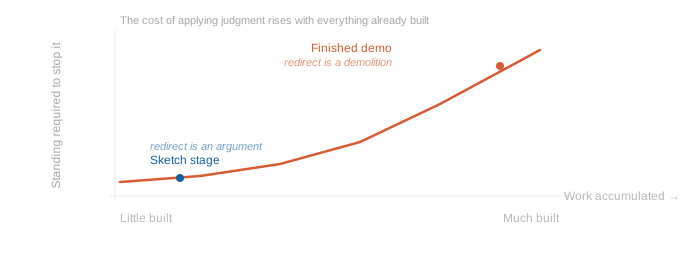
But presence is not the same as standing, and this is the part the tidy version of the story leaves out. Senior judgment does not apply itself. Someone has to spend standing to stop work that other people want, and the amount required scales with how committed the room already is. The brake was always bypassable, not because the judgment was absent, but because applying it has a price, and the person with the judgment does not always have enough to pay it.
AI Changed What a Beginner Can Put in the Room
The previous pieces in this series examined how AI accelerates throughput without proportionally accelerating understanding, how that gap accumulates as infrastructure exposure, and how organizational assimilation capacity must be deliberately built. The judgment problem sits underneath all of them. It is the mechanism through which the brake fails.
AI tooling has lowered the barrier to producing something that looks finished. A person who previously needed a senior engineer to scaffold an architecture and validate the approach can now reach a credible-looking artifact without that engagement. The thing compiles and passes its tests and can be put in front of a room. Whether it should exist, whether it holds at scale, whether its failure modes were ever considered, none of that has been asked, because the friction that used to force the asking is gone.
There used to be a natural delay between proposing an idea and demonstrating it. That delay was not merely implementation time. It was judgment time. The architecture conversation happened while the artifact still existed only as a sketch, which is exactly when it was cheapest to redirect. AI compresses that interval to nearly nothing. The proposal now arrives already implemented, carrying the persuasive weight of visible progress before anyone has asked whether the direction deserved to exist.
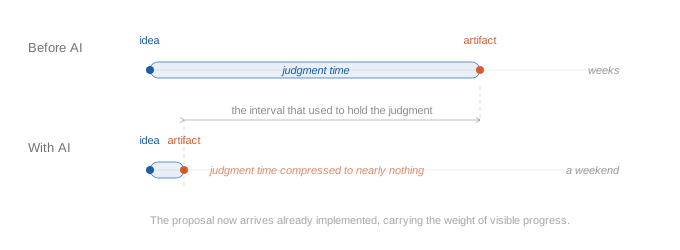
The consequence that matters is not that more unvetted work exists. It is what that work does to the conversation. A demo is concrete and present; an objection is abstract and predictive. When a less experienced person walks in with a running artifact and says this already works, they are no longer bringing an idea to be judged. They are bringing evidence, and evidence shifts standing. Stopping the work now means arguing against something the room can see, which costs far more than arguing against something it only imagined.
It is worth being precise about what AI does and does not change here. It does not make a manufactured artifact more persuasive than a skilled engineer’s happy-path mockup ever was. What it changes is who can make one. Producing a plausible artifact used to require enough skill that the person usually carried some judgment along with it. That filter is gone. The artifact can now be produced by someone who cannot yet tell a real solution from a probabilistic imitation of one, and it shifts standing in the room either way. At the edges of a system, where a wrong direction is cheap to unwind, that is survivable. On the parts everything else depends on, it is not, and that is exactly where a finished-looking artifact is most likely to be waved through.
The Demo Answers the Question Before Anyone Asks It
The pattern is older than the tooling, and the version that taught me to watch for it had nothing to do with AI. Years ago, in an advanced development group, a principal engineer spent several months on a proposal to simplify how users entered network addresses. The story does not rest on my read of the engineer. It rests on the math.
On demo day he presented a neural network, trained for weeks, that took an address and a network block and produced a verdict on whether the address fell inside the block. He reported about 85 percent accuracy, with a promise of 95 or better given more training. The problem is that this is a solved and deterministic question: convert both values to integers, apply the mask, compare. The answer is exact, instant, and correct every single time. He had spent months building a slower, probabilistic approximation of something a few lines of code do perfectly, and he was reporting a failure rate on a problem that has none.
And yet the demo worked, in the only sense that matters in a room. It was a running thing, weeks of visible effort with a confident accuracy number attached. Nobody had asked the deterministic question during the months of build-up, and by demo day the artifact had answered a different question in its place: not is this the right approach, but look how far along this already is. That is the trap: the work itself becomes the argument for continuing the work. When I sit in a demo now, the first thing I ask myself, silently, is whether we have just watched a very elaborate implementation of probabilistic XOR.
The same thing happens faster now, and to people with far less experience than a principal engineer. A small team produces a weekend of AI-assisted work and arrives Monday with a demo that has obvious gaps and is nonetheless further along than they could have reached unaided. The principal needed months to build enough sunk cost to make his direction hard to abandon. A weekend now buys the same momentum. Progress accumulates faster than the willingness to walk away from it, and a direction with enough built behind it stops being a proposal and becomes a train already moving, harder to stop with every day it runs. The artifact that shifts standing can now be manufactured by anyone, before anyone has asked whether the direction was right to begin with.
The senior engineer facing that Monday demo is in the position I was in, except the momentum arrived in two days instead of two months. Most of the time the outcome is a compromise: the work proceeds with modifications, some of which fix the real problem and some of which paper over it. The brake engaged, but late, partially, and only for whoever had the standing to force it.
Could the Model Be the Brake?
The obvious objection is that AI could sharpen judgment rather than route around it. If a senior engineer can evaluate ten approaches in the time one used to take, the model is not removing judgment from the loop, it is giving judgment more to work with. That is real, and I use models exactly this way: to pressure-test a proposal, surface failure modes I had not considered, and widen the option set before committing. They widen what I consider. They do not decide what I build.
But it does not fix the problem this piece is about. The model expands the options and the implementation at the same speed, so the moment someone must stop and ask whether this is the right direction arrives buried under more plausible-looking work, not sooner. Faster evaluation helps only if it still happens before the artifact hardens into the thing everyone can see, and nothing in the tooling guarantees that.
There is also a limit to what the model contributes to the judgment itself. Asked to choose an approach, it gravitates to the consensus of its training data, which is not the same as the approach best suited to the system in front of you. That gap widens in a way worth naming: when practice in a field consolidates after the model’s training cutoff, the model does not give you a generic answer, it gives you a confidently stale one, with no signal that the ground has moved. The model is a powerful instrument for the engineer exercising judgment and a poor substitute for that engineer.
What Organizations Are Losing
The most experienced engineers are increasingly consumed by the downstream consequences of AI-accelerated output: longer review queues, more validation, more incidents that require deep system knowledge to trace. The time being eaten is exactly the time that early judgment requires.
The assimilation capacity piece in this series described how senior engineers are becoming throughput governors rather than architects. That shift turns dangerous through precisely this mechanism. A throughput governor reviews work that already exists, which means reviewing artifacts that have already shifted the standing in the room and already accumulated the sunk cost that makes them hard to stop. An architect shapes work before it hardens, while the cost of changing direction is still an argument rather than a demolition. AI pours more work into the review queue while dismantling the forcing functions that once routed decisions through judgment before the artifact existed.
The organizations most at risk are not the ones misusing the tooling. They are the ones using it exactly as intended, where no one has noticed that the judgment layer they assumed was load-bearing is being routed around one plausible demo at a time.
Rebuilding the Forcing Function
The brake cannot be made unbypassable, and trying to restore pre-AI friction just discards the value of the tooling. The objective is not to slow the front of the pipeline. It is to make judgment engage before the artifact exists to argue for itself.
What organizations need is an explicit pre-artifact judgment checkpoint: a required point, before significant implementation begins, where the direction is examined while it is still only a direction. The mechanism can be lightweight. On teams where I have introduced it, the forcing function is a short written note, not a design review, not an RFC, something that fits in a Slack thread. It answers three questions, and the questions are deliberately unremarkable. What matters is that they get asked at all, and early enough that the answers can still change the direction.
Before implementation begins, answer:
- What problem is this actually solving?
- What are the failure modes at scale?
- Has anyone with relevant experience seen this shape before?
The third question is the one that does the work. It activates institutional memory before the code exists rather than after, and it does something subtler than that. By making the engagement a required early gate, it removes the need to spend standing to force it. No one has to fight the momentum of a finished demo, because the conversation happens before the demo can be built. The standing problem dissolves when the judgment is scheduled instead of fought for.
The asymmetry is worth stating plainly. The conversation before the work begins costs thirty minutes. The same conversation after the work is built, demonstrated, and carrying its author’s attachment costs days, plus the standing someone has to spend to stop it. AI has not changed that asymmetry. It has raised the stakes on both sides, letting the expensive side accumulate faster and be produced by more people.
Judgment Is Not a Bottleneck to Optimize Away
The efficiency framing of AI in engineering treats everything that slows output as a candidate for removal. Review cycles are latency. Approval gates are friction. Senior engagement before implementation is overhead.
Judgment is not overhead. It is the one function AI does not accelerate. Generation got faster, iteration got faster, the manufacture of convincing artifacts by people who cannot yet judge them got faster. The decision about whether any of it should be built did not. And this is not about catching bugs; a well-run pipeline catches those downstream in review and testing. Judgment upstream answers a question testing never asks: whether this is the right thing to build at all. Remove it and the pipeline still runs clean and passes its tests while producing, faster and more convincingly than before, work that was aimed wrong from the start. The cost shows up as a rising fraction of senior time spent unwinding directions that early judgment would have redirected, on teams that mistook that judgment for the thing slowing them down.
The organizations that keep the judgment step deliberate, routed through early rather than accumulated at the end, are the ones for whom AI’s speed compounds with engineering experience instead of grinding against it. The feature the product manager wanted was never built. Killing it took several uncomfortable conversations and an intervention from someone with the standing to make it stick, because by then the concept was sold and the momentum was real. The arithmetic took thirty minutes. Getting it heard took everything else. The whole point of routing judgment in early is to engage it before standing becomes expensive to spend.