
Not long ago I was advising a CTO who had shipped a product under real competitive pressure. The team had used AI tooling heavily throughout, and the result looked credible: a working system, a live demo, a technical story that held together in a pitch room. When I asked how the system would behave under load, how it handled state across failure boundaries, what would happen to data integrity if a dependency became unavailable, the conversation stalled. The artifact existed. The system did not exist in anyone's head. No one had done anything wrong in the conventional sense. They had taken advantage of tools that genuinely reduced execution friction. But the system that emerged was, in a meaningful way, unexaminable. That is a different kind of risk than teams are accustomed to managing. A system that cannot be explained is not ready to be operated.
This pattern is not new, and it is not unique to AI. In both cases, the cloud migration wave and the microservices era, the dynamic was the same: engineers deployed more infrastructure, more APIs, more product surface area than the organization could keep up with understanding. Cloud adoption let teams provision at a pace that outran their grasp of what they were operating. Microservices let teams decompose and redeploy faster than anyone fully grasped the resulting dependency graph. Each major platform transition, from server room to cloud, monolith to microservice, and chroot and cgroups to Docker and Kubernetes, lowers the friction required to produce working systems and raises the friction required to understand them. AI is the current iteration of that pattern, and it is moving faster than its predecessors.
Code Production Was Never the Hardest Part
For most mature engineering organizations, typing code has not been the primary bottleneck for some time. The real constraints have lived elsewhere: designing coherent systems, integrating change safely, reviewing work at sufficient depth, testing across realistic conditions, maintaining architectural clarity as complexity accumulates, and releasing to production before requirements change. AI tooling has dramatically increased the rate at which new change can be introduced into these already constrained pipelines. This is often experienced as productivity. In practice, it is throughput pressure.
When code generation becomes easier, organizations do not automatically become better at absorbing change. Review queues lengthen. Integration complexity rises. Test infrastructure becomes saturated, and the fact that AI is also accelerating test generation does not resolve this. The constraint is not writing tests. It is the reasoning over what they actually cover. Senior engineers spend increasing amounts of time validating work whose surface quality may be high but whose systemic implications are not understood. The visible output of the organization increases. The invisible cost of operating the resulting systems increases alongside it. The gap shows up most clearly in how work is reviewed and accepted.
The Illusion of Architectural Competence
That opening story exposes a specific calibration failure. When execution friction drops, the signals organizations use to evaluate technical maturity become distorted. Leaders may overestimate their ability to operate complex infrastructure because they have successfully constructed artifacts that appear production-ready.
A different team I worked with built a custom decryption mechanism for their API gateway using Envoy proxy. It required a new underlying stack for performance. Everything tested correctly. The benchmark numbers were good. The system held up fine under synthetic load. In production, under real traffic, the deployment ran out of file descriptors, first taking down Envoy, then cascading to the underlying stack and the DPDK distributor, and resulting in a full service denial. The load, stress, and shadow deployment testing had been thorough by every reasonable measure. It just had not been done against the actual connection patterns of actual users. The failure mode was not exotic, and it was not testing coverage. The failure was the team's ability to model how the system would behave under real conditions. The system worked exactly as built, but without anyone understanding it.
Research on AI in high-skill knowledge work describes this as a jagged technological frontier: the boundary inside which AI reliably boosts performance and outside which it quietly degrades it. A credible-looking system offers no signal about which side of that frontier an organization is actually operating on. This ambiguity is new. Historically, broken systems appeared broken. Both failures described here share the same underlying structure: the gap between what testing can approximate and what production reveals.
Change Throughput vs. Assimilation Capacity
One useful frame for this shift is assimilation capacity. Every engineering organization has a finite ability to comprehend new system behavior, propagate architectural context, detect unintended interactions, develop less experienced engineers, and make informed tradeoffs under uncertainty. Historically, change throughput was constrained enough that these assimilation processes could keep pace. AI-assisted development is beginning to decouple those rates.
When the volume of change increases faster than the organization's capacity to internalize its consequences, risk accumulates as fragility, not defects. Systems become harder to reason about. Ownership boundaries blur. Documentation lags reality. Institutional memory erodes. Recovery from incidents becomes slower because fewer people understand how the system actually behaves under stress.
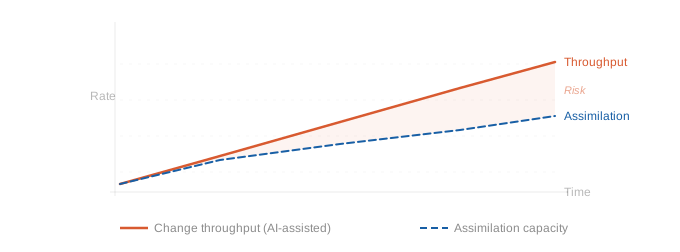
From an economic perspective, this is not a technical concern. It is a capital allocation problem. Organizations are already paying for this gap through increased incident recovery time, duplicated systems, overprovisioned infrastructure, and senior engineering time spent validating work that should have been understood upstream. Engineering effort, infrastructure expenditure, and opportunity cost are increasingly being spent operating complexity that was introduced faster than it could be strategically absorbed. This cost is real whether the underlying platform is cloud-native, ML-based, or something that does not yet have a name.
Pressure Across Three Planes
These dynamics do not remain confined to team process. They propagate into infrastructure behavior across three interacting planes: control, data, and artifact. On the control plane, increased deployment velocity introduces coordination instability: retries amplify, dependencies multiply, and failure domains become harder to reason about ahead of time. On the data plane, accelerated rollout drives nonlinear cost effects as encryption overhead, placement decisions, and processing architecture choices interact at scale in ways that small-environment testing does not surface. On the artifact plane, faster experimentation leads to greater replication of long-lived strategic assets, each copy expanding the lifecycle surface that must be secured, governed, and eventually retired.
The most effective intervention I have found is simple: require that any pull request containing AI-assisted code include a human-written explanation of what the change does, what its failure modes are, and why this approach was chosen over alternatives. Reviewers are then expected to assess whether that explanation reflects genuine understanding or surface familiarity. It does not meaningfully slow development, but it changes where thinking happens. The engineer who submitted the code has had to reason about it, and the reviewer is checking for comprehension, not just correctness. That distinction matters when the thing being reviewed is a system that will need to be operated, debugged, and evolved by someone other than the person who generated it.
Organizations do not need to slow down what engineers produce. They need to control how that output propagates across team boundaries and into the rest of the system. Getting that constraint right is an internal organizational problem. But the exposure accumulating on those same boundaries is also being shaped by forces the organization does not control: an adversarial environment that is becoming more capable, regulatory pressure that is becoming less forgiving, and cryptographic assumptions that have a known expiration date.
The Emerging Constraint Surface
AI has changed the economics of building software. It has not eliminated the consequences of operating it. The emerging constraint surface is not defined solely by model capability or compute availability. It is shaped by how quickly organizations can convert accelerated experimentation into durable understanding.
As that capability gap widens, exposure accumulates: not just in the code, but in the trust assumptions embedded in system boundaries, the cryptographic posture protecting long-lived assets, and the organizational knowledge required to reason about how it all behaves under stress. This pattern has repeated across every major platform transition: from server room to cloud deployment, monolith to microservice, chroot and cgroups to Docker and Kubernetes. The current iteration simply moves faster and operates at higher asset value than those before it. The systems being built are not becoming simpler. The only question is whether understanding keeps pace with their creation.
How that exposure compounds across control, data, and artifact planes is the subject of the next piece in this series.